Bow Item Number: Na992 from the MOA: University of British Columbia

Description
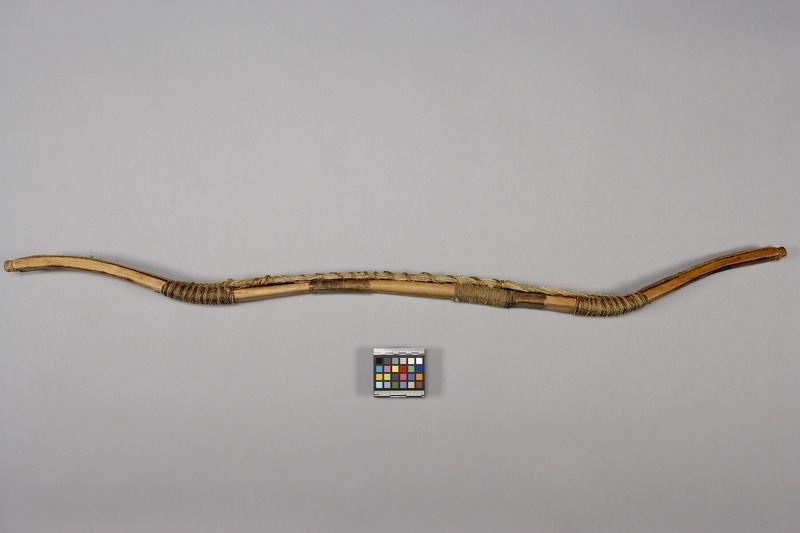
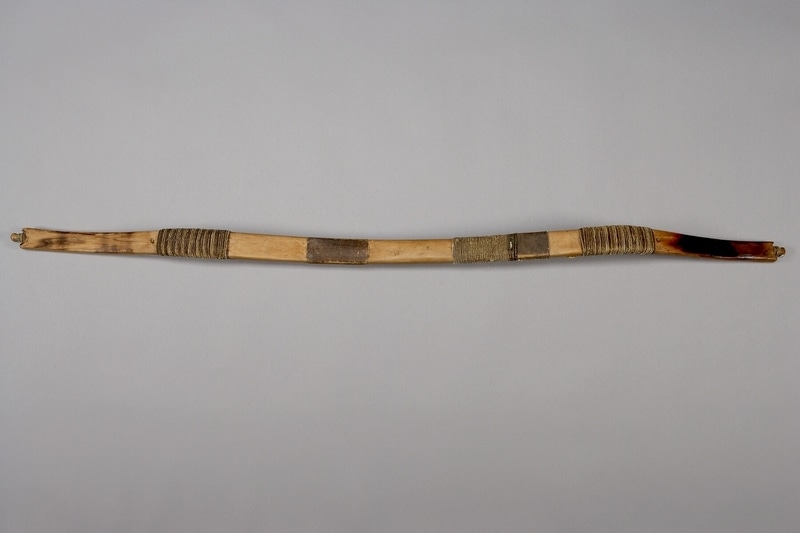
Cable-backed bow made from wood and other materials. There are 2 places where thin pieces of bone have been attached to either side of the wood with copper pins, one has sealskin sewn over the top of the bone, and the other has sinew lashed over it. There are knobs on either end of the bow, around which 8 braided sinew cords are strung. The cords are lashed onto the wood in 2 places, and they are twisted and wound with sealskin in the middle section. (Bow string no longer attached.)
History Of Use
Bows were used for hunting land animals such as caribou and birds, and occasionally for warfare.
Narrative
Said to have been collected in the MacKenzie District, southwest of Victoria Island and northeast of Bear Lake.
Specific Techniques
Cable-backed bows are bows reinforced with a braided cable along the back. Cables are attached to the bow at intervals, and tightened once placed. They decrease pressure on the bow’s back, increase its strength, and decrease its chance of breaking. The tighter the cable, the greater these effects. Cable-backed bows can have a variety of profile shapes: recurve, straight, etc.
Item History
- Made in Nunavut, Canada
- Owned by Tradewind Antiques before December 12, 1984
- Received from Museum of Anthropology Donations Fund (Funding source) and Tradewind Antiques (Seller) on December 12, 1984
What
Who
- Culture
- Inuit
- Previous Owner
- Tradewind Antiques
- Received from
- Museum of Anthropology Donations Fund (Funding source) and Tradewind Antiques (Seller)
Where
- Holding Institution
- MOA: University of British Columbia
- Made in
- Nunavut, Canada
When
- Ownership Date
- before December 12, 1984
- Acquisition Date
- on December 12, 1984
Other
- Condition
- fair
- Current Location
- Case 51
- Accession Number
- 1009/0002