Whaling Item Number: Nb11.335 from the MOA: University of British Columbia
Description
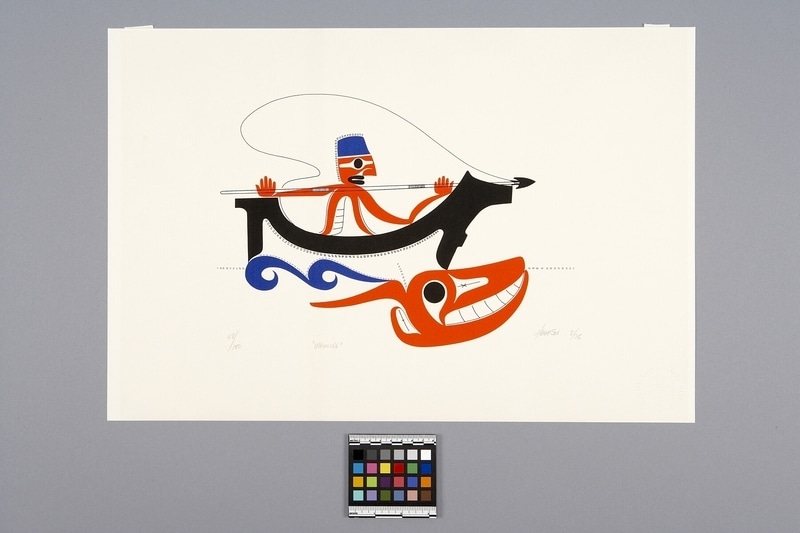
Stylized image of a whaler, in profile facing right, in a canoe holding a harpoon that rests on the bow. The harpoon shaft is outlined in black with lashings at two places. A line sweeps up above the whaler. Whaler is in red with a blue cap; two parallel dashed lines to outside of top and left side of cap. Round black eye and black lips. Right arm is out straight along harpoon, left arm curves down then up to harpoon. Canoe is black with two parallel dashed lines along curve at centre. Red profile whale with round black eye is below right side of canoe and has an open mouth with teeth row; two vertical, parallel dashed lines from spout and two blue wave curls behind whale on left. Two parallel dotted lines indicate water on either side of canoe. Single blue dotted line follows curls. Pencil inscription below image: "48/100 Whaling AThompson 8/78." Embossed circular stamp at lower right: Canadian Native Prints Limited, with salmon at centre.
History Of Use
Northwest Coast serigraphs are a contemporary art form, deriving from early 20th century drawings of traditional crest and decorative designs, commissioned by anthropologists and undertaken by artists such as Charles Edenshaw. Residential schools reinforced the medium, while discouraging the use of traditional themes. An important series of traditional designs in coloured pencil and watercolour were done by Mungo Martin for UBC in 1949-50. The 1960's saw the rapid growth of prints, first in unlimited poster editions, and later with the establishment of the Gitanmaax School of Northwest Coast Indian art at 'Ksan (1967), and of the Northwest Coast Indian Artists Guild (1977), limited edition art runs became the standard. Northwest Coast silkscreen prints are part of the mainstream art market, as well as functioning within the native context as potlatch gifts, and commemorative prints. Although there are distinctive regional styles, individual artists may work in several styles, or apply unique themes and variations to specific works.
Cultural Context
contemporary art
Item History
- Made by Art Thompson (Maker) in British Columbia, Canada during 1978
- Owned by Canadian Native Prints Ltd. before August 14, 1980
- Received from Canadian Native Prints Ltd. (Donor) on August 14, 1980
What
- Name
- Whaling
- Identification Number
- Nb11.335
- Type of Item
- Manufacturing Technique
- silkscreened
- Overall
- height 37.5 cm, width 56.0 cm
Who
- Culture
- Nuu-chah-nulth: Ditidaht
- Creator
- Art Thompson (Maker)
- Previous Owner
- Canadian Native Prints Ltd.
- Received from
- Canadian Native Prints Ltd. (Donor)
Where
- Holding Institution
- MOA: University of British Columbia
- Made in
- British Columbia, Canada
When
- Creation Date
- during 1978
- Ownership Date
- before August 14, 1980
- Acquisition Date
- on August 14, 1980
Other
- Item Classes
- works on paper
- Condition
- good
- Current Location
- Case 9
- Accession Number
- 0651/0007