Crawling Wolf Item Number: Nb11.306 from the MOA: University of British Columbia
Description
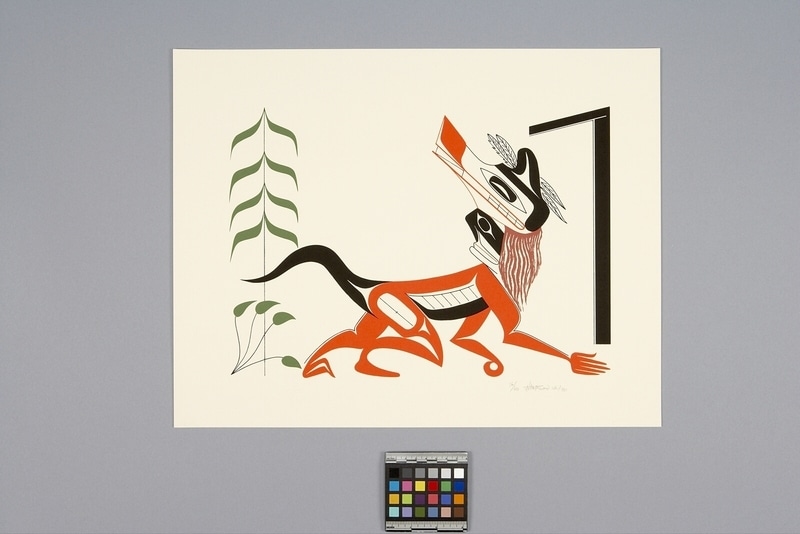
A main design consisting of a profile of a stylized standing wolf moving towards the right. Head is turned back facing to the left. In black with dark orange wolf headdress with four feathers and red-brown cedar bark fringe. Face has a black band across the nose and the eyes. Limb in dark orange while the tail, torso and ribs are in black. Stylized olive green tree and bush on the left. Straight, black, thick, vertical band on the right with a short, smaller band across the top sloping down towards the figure. Both bands have thin parallel line at the inside edge. Pencil Inscription along the bottom edge reads '16/60 A. Thompson 12/80'. There is an embossed stamp below the image on the left that reads 'Open Pacific Graphics'. The print is on horizontally rectangular, beige paper.
History Of Use
Northwest Coast serigraphs are a contemporary art form, deriving from early 20th century drawings of traditional crest and decorative designs, commissioned by anthropologists and undertaken by artists such as Charles Edenshaw. Residential schools reinforced the medium, while discouraging the use of traditional themes. An important series of traditional designs in coloured pencil and watercolour were done by Mungo Martin for UBC in 1949-50. The 1960's saw the rapid growth of prints, first in unlimited poster editions, and later with the establishment of the Gitanmaax School of Northwest Coast Indian Art at 'Ksan (1967), and of the Northwest Coast Indian Artists Guild (1977), limited edition art runs became the standard. Northwest Coast silkscreen prints are part of the mainstream art market, as well as, functioning within the native context as potlatch gifts, and commemorative prints. Although, there are distinctive regional styles, individual artists may work in several styles, or apply unique themes and variations to specific works.
Narrative
This print was privately commissioned and given away by Open Pacific Graphics, Victoria, at Christmas 1980 and was not released commercially.
Cultural Context
contemporary art
Iconographic Meaning
The stylized tree and bush symbolize the forest, the black bands represent a Nuu-chah-nulth style house. The crawling wolf is an important character in Nuu-Chah-nulth ceremonial performances.
Item History
- Made by Art Thompson (Maker) in British Columbia, Canada during 1980
- Owned by Open Pacific Graphics before January 8, 1981
- Received from Open Pacific Graphics (Donor) on January 8, 1981
What
- Name
- Crawling Wolf
- Identification Number
- Nb11.306
- Type of Item
- Manufacturing Technique
- silkscreened and printed
- Overall
- height 37.5 cm, width 48.2 cm, depth 0.1 cm
Who
- Culture
- Nuu-chah-nulth: Ditidaht
- Creator
- Art Thompson (Maker)
- Previous Owner
- Open Pacific Graphics
- Received from
- Open Pacific Graphics (Donor)
Where
- Holding Institution
- MOA: University of British Columbia
- Made in
- British Columbia, Canada
When
- Creation Date
- during 1980
- Ownership Date
- before January 8, 1981
- Acquisition Date
- on January 8, 1981
Other
- Item Classes
- works on paper
- Condition
- good
- Accession Number
- 0699/0001