Prayer Wheel Item Number: Ee4.43 a-c from the MOA: University of British Columbia

Description
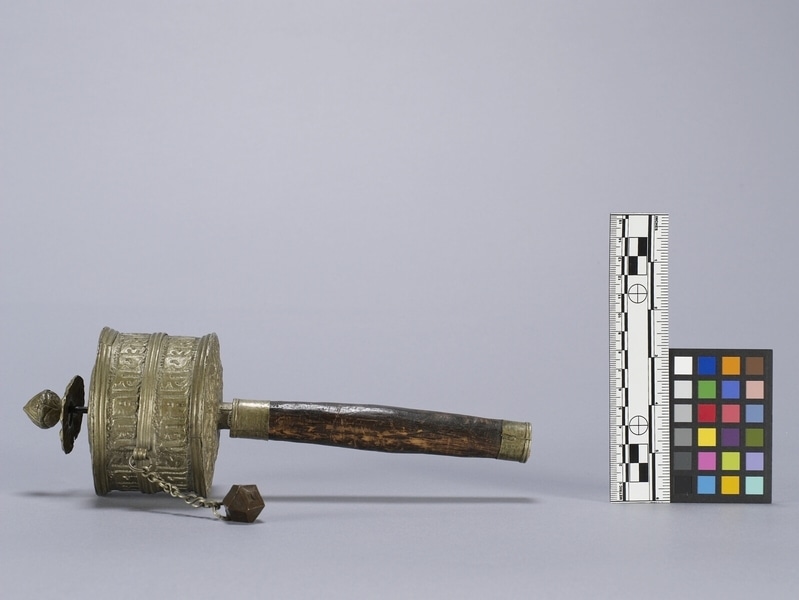
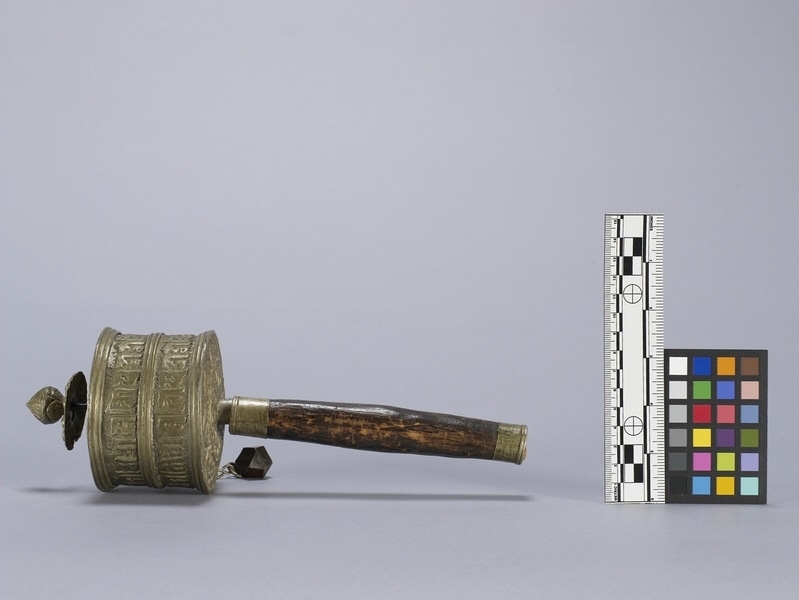
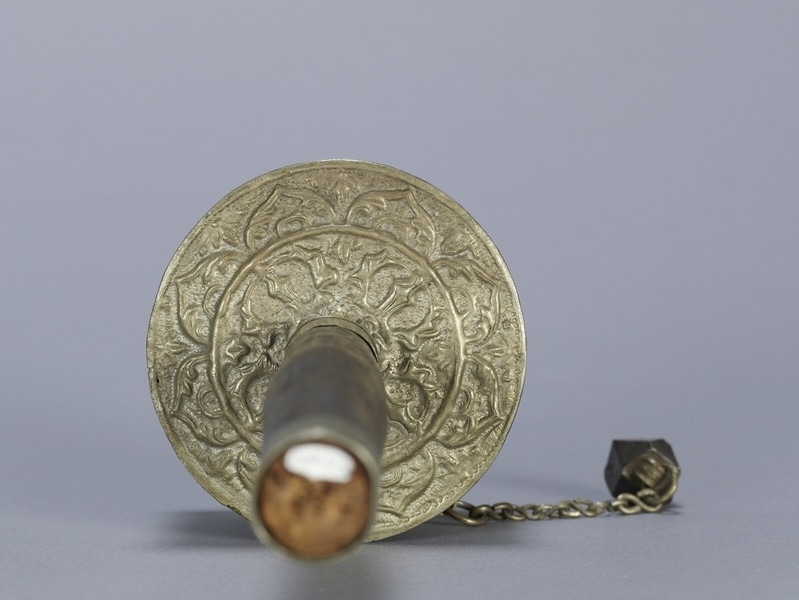
Tibetan prayer wheels are called mani khorlo (མ་ཎི་འཁོར་ལོ།). Silver-coloured, cylindrical metal mani khorlo covered covered in repoussage metalwork, with two bands of Sanskrit text inscribed in Lantsa script conveying iterations of **||Om mani padme hum|, the sacred six-syllable mantra for Avalokitesvara (part b); a bud-shaped finial with a flat, circular base is featured on the top (part c), while a metal chain with a polyhedron finial is attached to the side. Cylinder is mounted on dark brown wooden handle capped with metal (part a), about which it turns.
History Of Use
The handheld mani khorlo (མ་ཎི་འཁོར་ལོ།) or prayer wheel spins with the movement of the wrist, while the stone on the short chain sustains the momentum. The wrapped spindle is known as the “life tree.” The top and bottom of the cylinder are adorned with stylized lotus blossoms, an auspicious symbol of one’s progression from delusion to enlightenment. In spinning the wheel, the practitioner reaps the same benefits of having read the countless prayers coiled inside, a useful means for illiterate Buddhists to attain merit. The wheel should be spun clockwise to coincide with the sun’s movement and the direction of the writing on the wheel to facilitate the release of the blessings into the world.
Cultural Context
Mani khorlo (མ་ཎི་འཁོར་ལོ།) or prayer wheels are ritual objects used in Tibetan Buddhist culture.
Item History
- Made in Tibet
- Collected between 1890 and 1900
- Owned by Albert Poole, Louise Eleanor Poole and F. Abner Poole before March 15, 1982
- Received from Albert Poole (Donor), F. Abner Poole (Donor) and Louise Eleanor Poole (Donor) on March 15, 1982
What
- Name
- Prayer Wheel
- Identification Number
- Ee4.43 a-c
- Type of Item
- prayer wheel
- Material
- metal, wood and lead metal ?
- Manufacturing Technique
- repoussage
- Overall
- height 28.5 cm, diameter 8.7 cm
Who
- Culture
- Tibetan
- Previous Owner
- Albert Poole, Louise Eleanor Poole and F. Abner Poole
- Received from
- Albert Poole (Donor), F. Abner Poole (Donor) and Louise Eleanor Poole (Donor)
Where
- Holding Institution
- MOA: University of British Columbia
- Made in
- Tibet
When
- Collection Date
- between 1890 and 1900
- Ownership Date
- before March 15, 1982
- Acquisition Date
- on March 15, 1982
Other
- Item Classes
- metalwork
- Condition
- fair
- Accession Number
- 0787/0014 a-c