Panel Item Number: 1198/5 from the MOA: University of British Columbia
Description
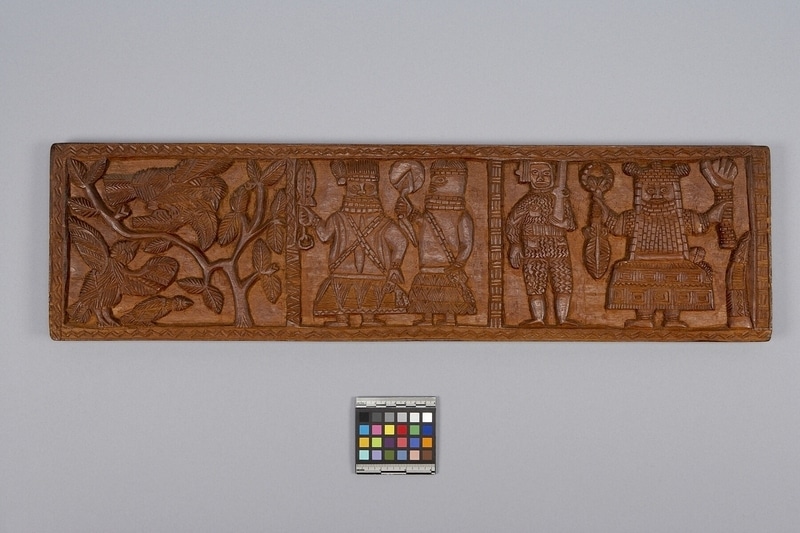
Wooden panel or plaque. Rectangular piece of carved wood, with a zigzag patterned frame carved in relief. Divided into three distinct carved scenes by two evenly spaced geometric carved lines. The first section of the panel depicts two large birds and one small bird flying among tree branches and leaves. The centre section of the panel depicts two human figures standing upright, one facing ahead and one turned to the side to face the other figure. Both are holding items in their right hand. The last section of the panel depicts two figures standing upright, both facing ahead, with one figure holding an item in his left hand and the other figure holding items in both hands. The garments worn by the human figures are elaborately engraved with geometric patterns.
History Of Use
This wooden panel is part of a tradition of historical documentation that originally came from the historical Benin Kingdom. Similar to the style and composition of the famous Benin bronze plaques, wooden panels depict historical events and traditions, and they contain stories, moments and motifs.
Iconographic Meaning
This plaque comprises three distinct storylines. On the left is ahianmwe-oro, the “Benin bird of prophecy.” Here it symbolizes the prophesied doom and defeat to Prince Osawe when he battled his older brother Arhuaruan over succession. With the help of his mother, Idia ni Esigie, Prince Osawe was victorious and became Oba Esigie, King of Benin. In the centre he is portrayed as the Oba with coral beads. Finally, the section to the right describes the help Oba Esigie received from Portuguese soldiers in defeating his enemies. He was the first oba to create a diplomatic relationship with a Western power. He holds an ikegobo in his left hand: a sort of trophy symbolizing his triumph over the ahianmwe-oro.
Narrative
This panel was previously owned by the donor's father, Reverend Banfield, who was a missionary, mainly in West Africa, from 1901 to c. 1930. He worked for many years among the Nupe people in interior Nigeria.
Specific Techniques
Carved using subtractive technique.
Item History
- Made in Nigeria ? between 1900 and 1930
- Owned by Alexander Banfield before 1949
- Owned by Althea Fullerton before February 26, 1987
- Received from Althea Fullerton (Donor) on February 26, 1987
What
Who
- Culture
- Nupe ?
- Previous Owner
- Alexander Banfield and Althea Fullerton
- Received from
- Althea Fullerton (Donor)
Where
- Holding Institution
- MOA: University of British Columbia
- Made in
- Nigeria ?
When
- Creation Date
- between 1900 and 1930
- Ownership Date
- before 1949 and before February 26, 1987
- Acquisition Date
- on February 26, 1987
Other
- Item Classes
- carvings & sculpture
- Condition
- good
- Accession Number
- 1198/0005