Iwami Kagura Mask Item Number: Ed5.2489 from the MOA: University of British Columbia
Description
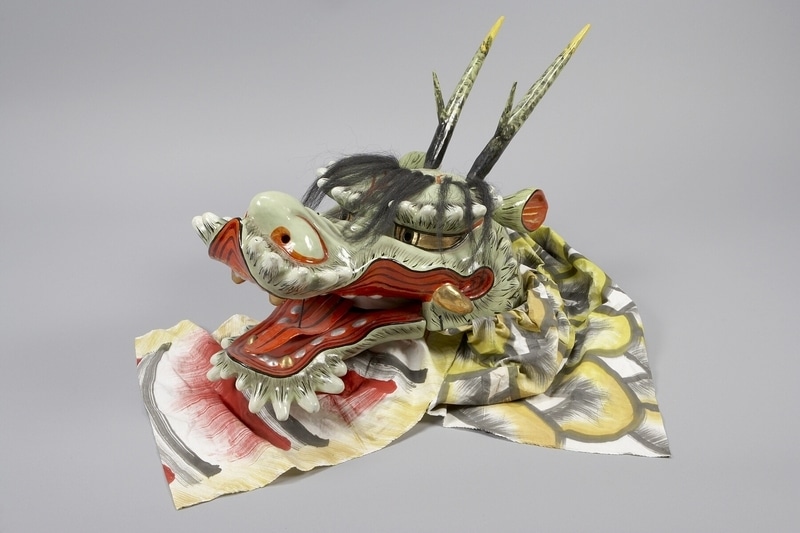
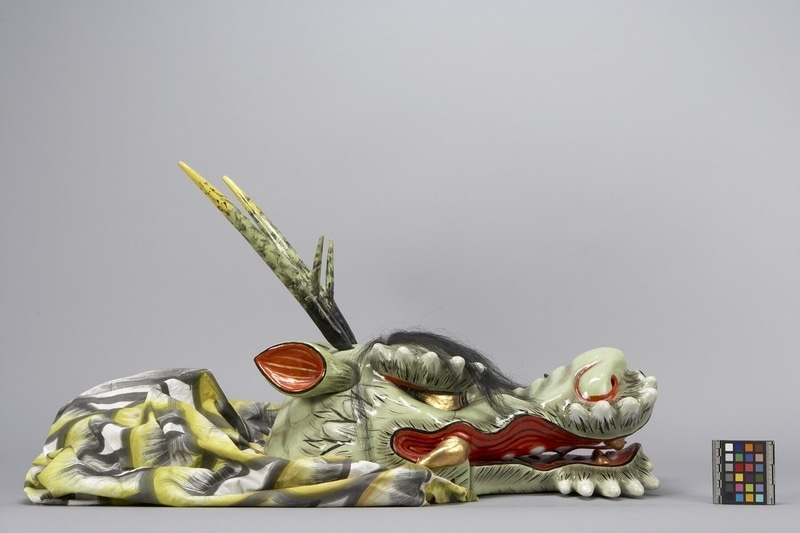
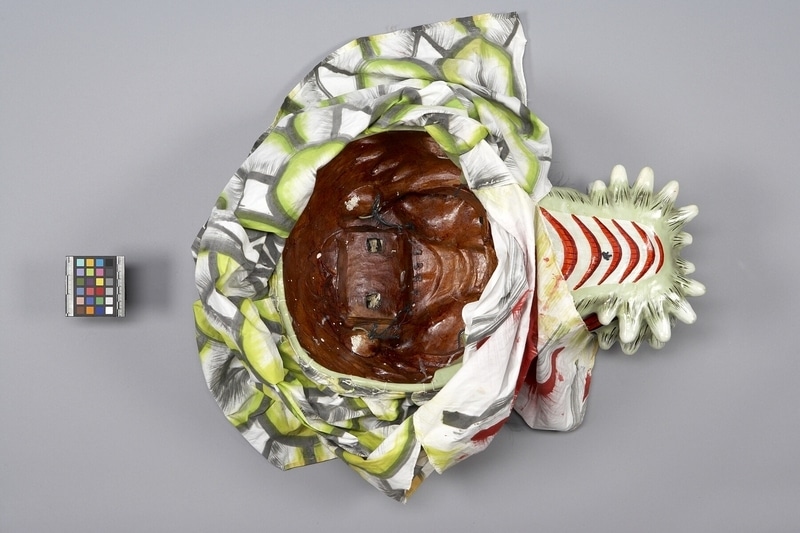
Iwami kagura mask (Iwami kagura-men;石見神楽面), made of paper mâché, of a serpent-like face with a movable jaw and ears, a long snout, and two protruding pointed antler-like appendages at the top of the head. Strands of long black hair are attached via holes across the top of the brow. The mask is painted light green with a red mouth and tongue, red inner ears, gold teeth and eyes, red around the nostrils, black at the base of the antlers and yellow at the tips, and lines in black, grey and white are used to create the illusion of hair around the lips, on the ears, and on the eyebrows. Two pieces of white fabric are attached at the bottom of the mask and painted with scales in dark grey, yellow, orange and red.
History Of Use
A mask used in kagura (神楽), a type of Shinto ceremonial dance, originally performed at the Imperial court and later developed in its popular forms as a traditional performing art or folk dance. Iwami kagura masks (Iwami kagura-men; 石見神楽面) have been made since around 1870. This mask is a Iwami kagura mask (Iwami kagura-men; 石見神楽面), a local style of kagura known for its colourful costumes from the Iwami region of Shimane Prefecture, in western Japan. Iwami kagura was designated as Japanese heritage in 2019. Different regions across Japan have distinct a form of kagura (神楽). Kagura is thematically associated with mythologies in the Kojiki (古事記 or Records of Ancient Matter, compiled in 712) sand Nihon Shoki (日本書紀, also known as Nihongi 日本紀or Chronicle of Japan, compiled by 720). Stories are based on mythologies, legends and semi-historical accounts often involving gods and demons.
Narrative
Commissioned by the museum from Japanese mask-maker Iwamoto, Chikuzan, in 1984.
Iconographic Meaning
Represents Jagashira, the snake-head god, or demon.
Specific Techniques
Iwami Kagura masks (石見神楽面) were originally carved from wood, but nowadays made from lightweight, but strong washi paper. They are made by pasting together layers of Sekishū washi paper (石州和紙) made in Hamada City in Iwami region, which used to be called Sekishū region in Shimane Prefecture. This technique is called dakkatsu (脱活), which makes it possible to produce durable masks with various shapes.
Item History
- Made by Chikuzan Iwamoto (Maker) in Shimane, Japan during 1984
- Collected during 1984
- Owned by Chikuzan Iwamoto before June 18, 1984
- Received from Chikuzan Iwamoto (Seller) and Museum of Anthropology Shop Volunteers (Funding source) on June 18, 1984
What
Who
- Culture
- Japanese
- Creator
- Chikuzan Iwamoto (Maker)
- Previous Owner
- Chikuzan Iwamoto
- Received from
- Chikuzan Iwamoto (Seller) and Museum of Anthropology Shop Volunteers (Funding source)
Where
- Holding Institution
- MOA: University of British Columbia
- Made in
- Shimane, Japan
When
- Creation Date
- during 1984
- Collection Date
- during 1984
- Ownership Date
- before June 18, 1984
- Acquisition Date
- on June 18, 1984
Other
- Condition
- good
- Accession Number
- 0968/0008