Mirror Item Number: N1.207 from the MOA: University of British Columbia
Description
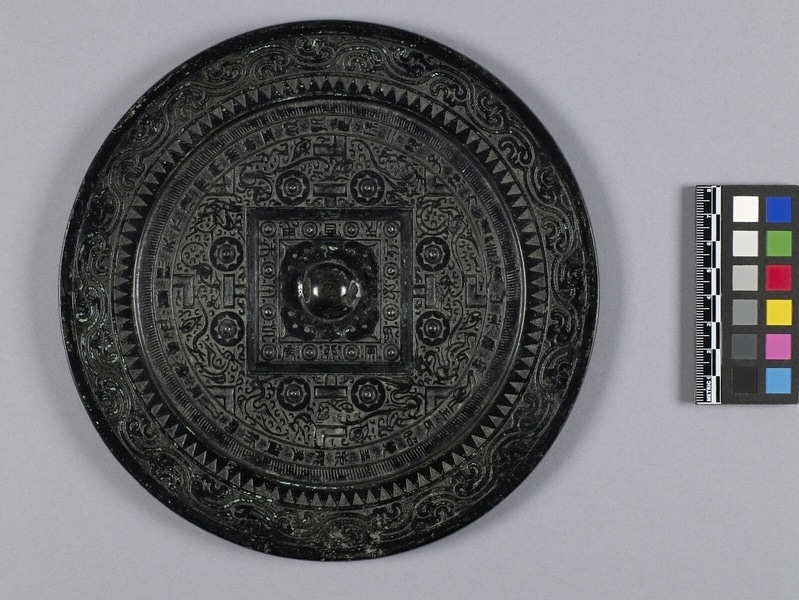
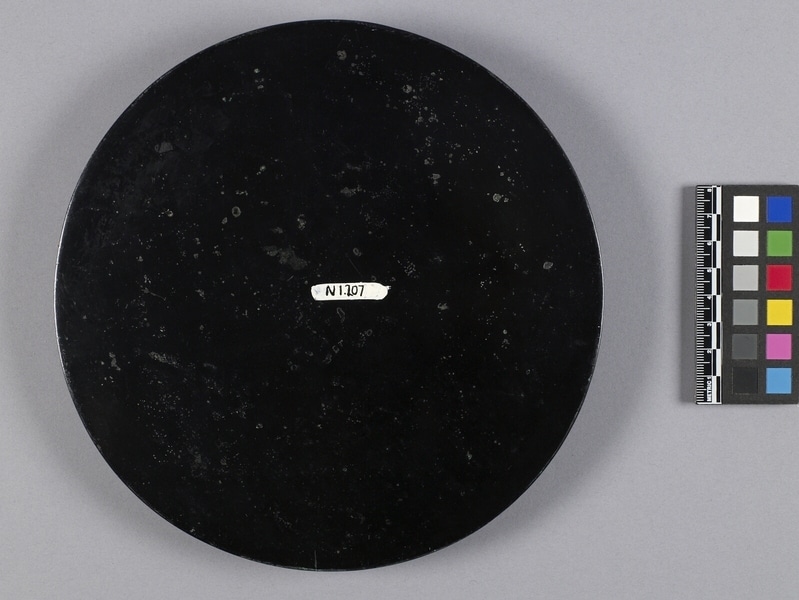
Flat circular metal piece. TLV mirror, representative of the universe, in black, plain boss handle in centre. Central semi-rounded knob is surrounded by a square, which is surrounded by eight smaller semi-rounded knobs. Circular design of archaic characters. Circular row of sunray-like pattern. Rim has swirl design around it. There are six concentric bands, four decorative and two inscriptional. The inner circle of inscriptions is framed in a square and lists the names of the twelve earthly branches, which correlate with the twelve intervals of the day, the twelve months, and the twelve zodiac animals. The outer inscriptional band begins with “Mr. Wang” and “new family” There are also three sets of T-, L-, and V-shaped marks. The reflective surface on the other side is now black from oxidation.
History Of Use
The mirrors of early imperial China could be used in daily life as part of one’s toiletries, but they were also prized as objects to be buried in tombs. Most mirrors of this period are bronze discs, with a smooth reflective surface on one side and designs on the other side that appear almost identical if you rotate the mirrors clockwise or counterclockwise.
Specific Techniques
High-tin bronze.
Iconographic Meaning
The characters on the mirror are in an ornamental seal script rather than the bureaucratic clerical style, a feature that underscores the auspicious and luxurious significance of the mirror itself. The three sets of T-, L-, and V-shaped marks symbolize the popular game of liubo chess and reference the sundial, a device for measuring solar time. The “Mr. Wang” and “new family” inscription on the outer band is possibly a reference to Wang Mang (r. 9–23 C E), founder of the short-lived Xin dynasty that briefly overthrew the Han.
Item History
- Made in China between 9 and 23
- Collected between 1921 and 1960
- Owned by Leslie G. Kilborn before October 1966
- Received from Fyfe-Smith Memorial Oriental Collection Fund (Funding source) and Leslie G. Kilborn (Seller) during October 1966
What
- Name
- Mirror
- Identification Number
- N1.207
- Type of Item
- mirror
- Material
- bronze metal
- Manufacturing Technique
- cast and lacquered
- Overall
- height 1.5 cm, diameter 19.9 cm
Who
- Culture
- Chinese
- Previous Owner
- Leslie G. Kilborn
- Received from
- Fyfe-Smith Memorial Oriental Collection Fund (Funding source) and Leslie G. Kilborn (Seller)
Where
- Holding Institution
- MOA: University of British Columbia
- Made in
- China
When
- Creation Date
- between 9 and 23
- Collection Date
- between 1921 and 1960
- Ownership Date
- before October 1966
- Acquisition Date
- during October 1966
Other
- Item Classes
- metalwork
- Condition
- fair
- Current Location
- Case 76
- Accession Number
- 0037/0090/0091