Arrow Sash Item Number: 3148/1 from the MOA: University of British Columbia
Description
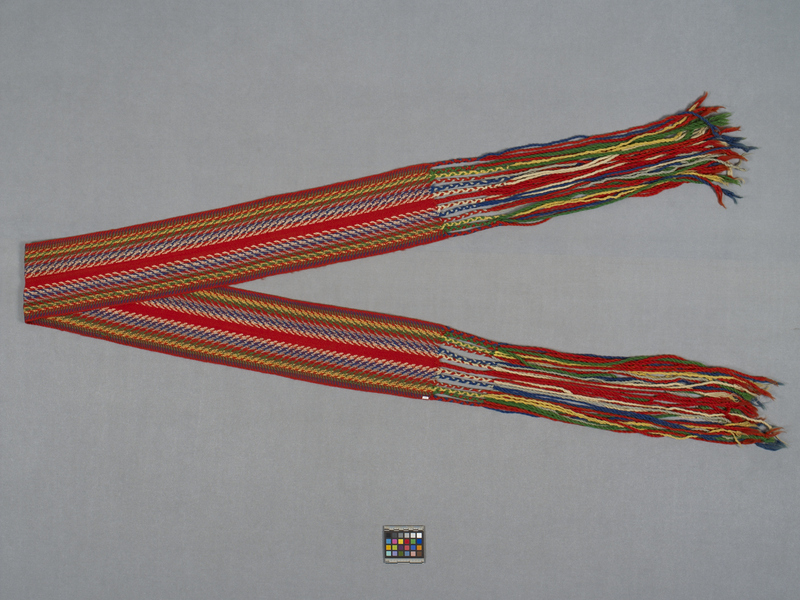
Finger woven red belt with multi-coloured pattern. The sash, or belt, is long and woven with lines of short diagonal stripes in blue, green, white and yellow on a bright red background. The wool is plaited into thick cords at each end, with the threads left long and unbraided.
History Of Use
The ceinture fléchée (also known as "L'Assomption sash" or "arrow sash") refers to this particular type of colourful woven sash. Métis wear them as part of their traditional regalia. They were also a traditional part of French-Canadian clothing of the 19th century, used by men to tie around their waists over jackets or coats.
Narrative
In 1966-67 the donors' mother was engaged to James Haining who, at that time, was the area administrator of Igloolik/Hall Beach. During that period she acquired a number of Inuit artifacts from Haining, as well as this sash. The sash is typically made and worn by Métis people, so it is unknown where Haining collected it.
Specific Techniques
Woven on a standing loom.
Iconographic Meaning
Yellow symbolizes prosperity, white represents the connection to the Creator, blue symbolizes water, green symbolizes earth, and red symbolizes the blood that has been, and is being spilled.
Item History
- Made in Canada before 1970
- Owned by Kim Armstrong before February 5, 2016
- Received from Kim Armstrong (Donor) on February 5, 2016
What
- Name
- Arrow Sash
- Identification Number
- 3148/1
- Type of Item
- sash
- Material
- wool fibre and dye
- Overall
- height 16.2 cm, width 312.0 cm
Who
- Culture
- Metis
- Previous Owner
- Kim Armstrong
- Received from
- Kim Armstrong (Donor)
Where
- Holding Institution
- MOA: University of British Columbia
- Made in
- Canada
When
- Creation Date
- before 1970
- Ownership Date
- before February 5, 2016
- Acquisition Date
- on February 5, 2016
Other
- Item Classes
- textiles
- Condition
- good
- Accession Number
- 3148/0001