Model Canoe Item Number: 3635/1 a-c from the MOA: University of British Columbia
Description
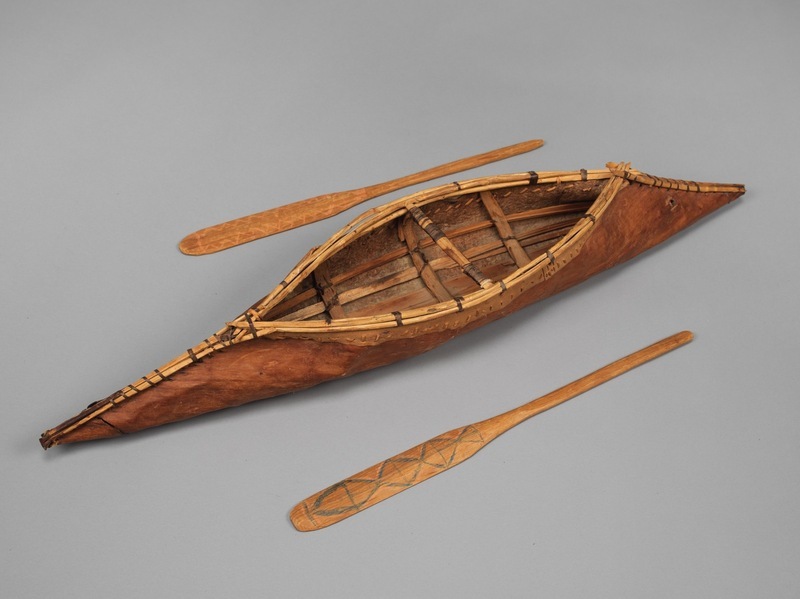
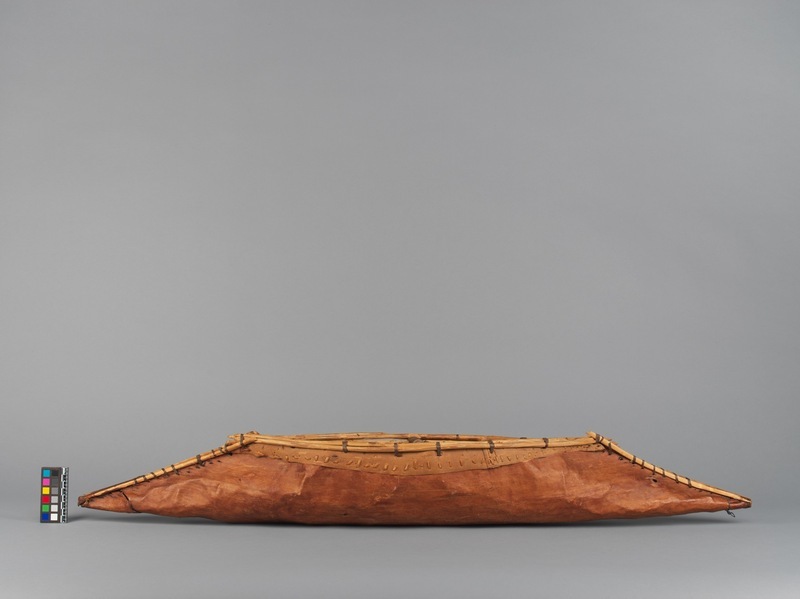
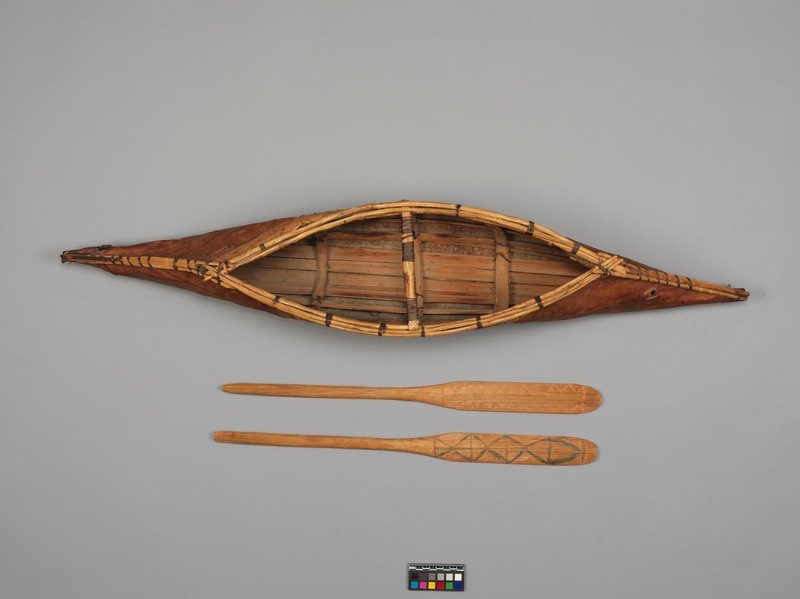
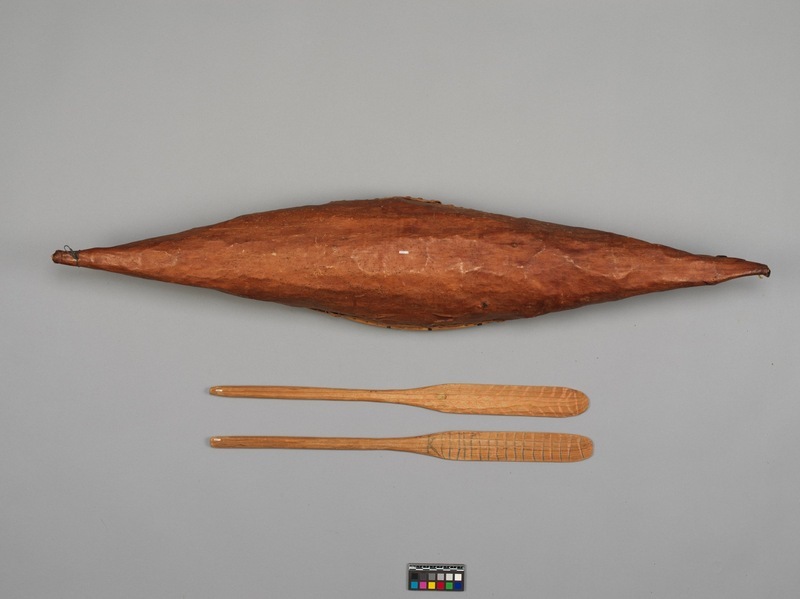
Model sturgeon-nosed bark canoe (part a) with two model wooden paddles (parts b-c). Canoe hull has a long, pointed bow and stern, creating sharp angles at the opening. The body is shaped with rib and slat frames, lashed together with bark and plant fibre. There is metal wire along the underside of the stern, and a small hide tie towards the middle of canoe (left side). There is one thwart across the middle of the canoe opening. Paddles have rectangular blades with flattened handles; designs painted in light red and dark blue across front and back of blades. Smaller paddle (part b) has connected diamonds with crosses through them on front; horizontal stripes across back. Larger paddle (part c) has zigzags painted and incised across front of blade; chevrons across back.
Specific Techniques
The slats are made of cedar; the lashes from cherry bark; the ribs and wood forming the frame are maple; the hull is made from the inner surface of birch bark; and the small holes in the hull have been sealed with fir pitch (Troy Hunter, 2025).
Narrative
From 1919 - 1936 the donors' grandfather, Richard G. Newton was superintendent of an Agricultural Experimental Station in Windemere, BC. After that they moved to Prince George, where Newton was assigned to direct an Experimental Farm in Pineview. The grandparents later retired in Chilliwack. The two donors, Hart and Brooks, inherited the collection from their father.
Item History
- Made in British Columbia, Canada between 1900 and 1936
- Collected in Windemere, British Columbia, Canada ? between 1919 and 1936
- Owned by Carolyn Hart and Denise Brooks before July 28, 2023
- Received from Carolyn Hart (Donor) and Denise Brooks (Donor) on July 28, 2023
What
- Name
- Model Canoe
- Identification Number
- 3635/1 a-c
- Type of Item
- canoe
- Material
- paint, birch bark, wood, plant fibre, cherry bark, metal and skin
- Overall
- height 12.4 cm, width 18.8 cm, depth 100.2 cm
Who
- Culture
- Ktunaxa
- Previous Owner
- Carolyn Hart and Denise Brooks
- Received from
- Carolyn Hart (Donor) and Denise Brooks (Donor)
Where
- Holding Institution
- MOA: University of British Columbia
- Made in
- British Columbia, Canada
- Collected in
- Windemere, British Columbia, Canada ?
When
- Creation Date
- between 1900 and 1936
- Collection Date
- between 1919 and 1936
- Ownership Date
- before July 28, 2023
- Acquisition Date
- on July 28, 2023
Other
- Condition
- fair
- Accession Number
- 3635/0001 a-c