Gelede Mask Item Number: 3692/8 a-b from the MOA: University of British Columbia
Description
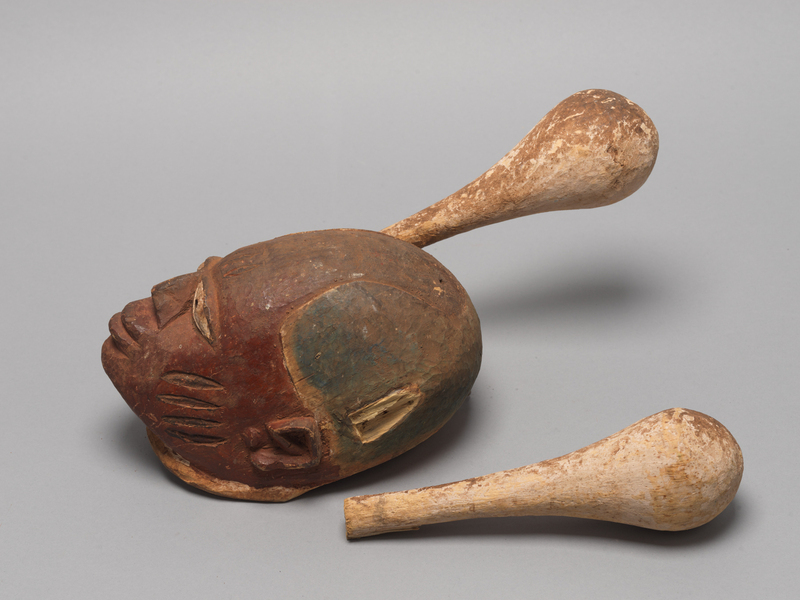
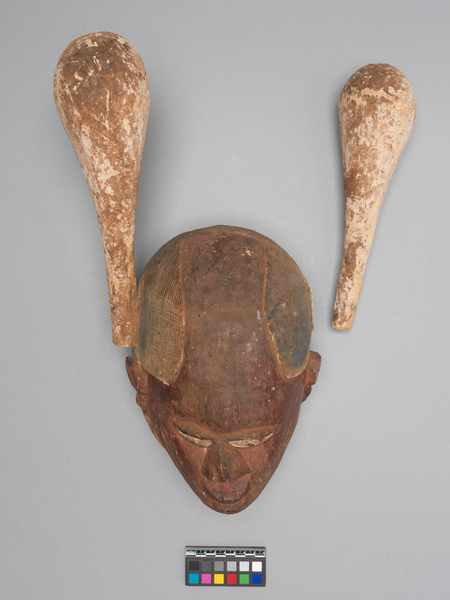
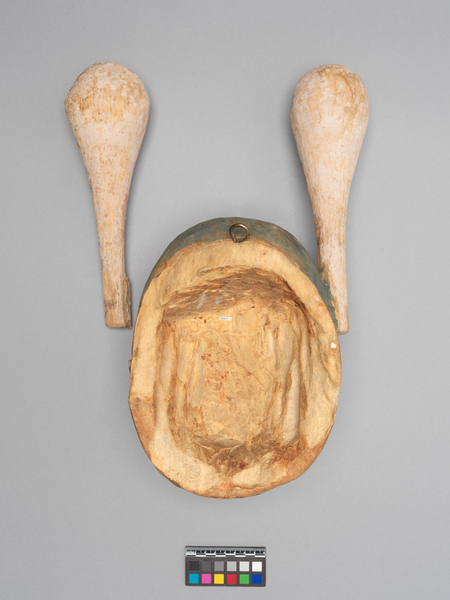
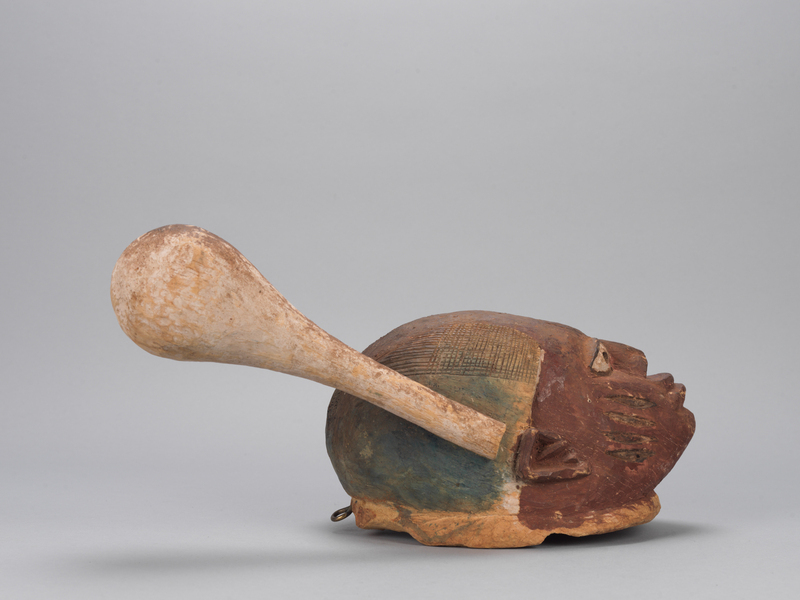
Gelede mask (part a) that depicts a squat human face with horns; left horn is separate (part b). Face has protruding eyes, triangular nose, and pointed lips; carved ears rest flat against head. Pupils drilled out. Scarification on the cheeks, four diagonal lines, and on forehead, three vertical lines. Top and sides, of upper half of mask, are raised; right side is partially cross-hatched. Eyes are white, outlined in black, and scars are painted black; face is painted red-brown, and upper section is dark green-blue. White horns consist of large ovals that narrow into cylinders; cylinder sections attach to sides of head with nails. Hole drilled into top centre of mask. Interior is roughly carved out and undecorated. Ring attached to top edge, for hanging purposes.
History Of Use
The gélède mask is worn more like a headdress, on top of the head, by male dancers. The masks are worn during Yoruba Gelede festivals which honour women, both living and dead, in particular the powerful "Mothers" (awon iya wa), a group that includes female ancestors and deities, as well as elderly women of the community. When dancers perform the Gelede dance they are displaying the powers of their female ancestors, who are considered to the beginning of the nation, makers of community and the protectors of children. They have the ability to affect the wellbeing of individuals or the community in positive and negative ways. The Gelede ceremony is divided into two parts: the efe, which takes place at night and features a humorist praying for the community, and the ijo osan, the daytime dance that is commonly referred to as Gelede.
Cultural Context
Gelede festival dances.
Item History
- Made in Nigeria
- Collected during 1965
- Owned by Ruth Phillips before February 26, 2025
- Received from Ruth Phillips (Donor) on February 26, 2025
What
Who
- Culture
- Yoruba
- Previous Owner
- Ruth Phillips
- Received from
- Ruth Phillips (Donor)
Where
- Holding Institution
- MOA: University of British Columbia
- Made in
- Nigeria
When
- Collection Date
- during 1965
- Ownership Date
- before February 26, 2025
- Acquisition Date
- on February 26, 2025
Other
- Condition
- poor
- Accession Number
- 3692/0008 a-b